
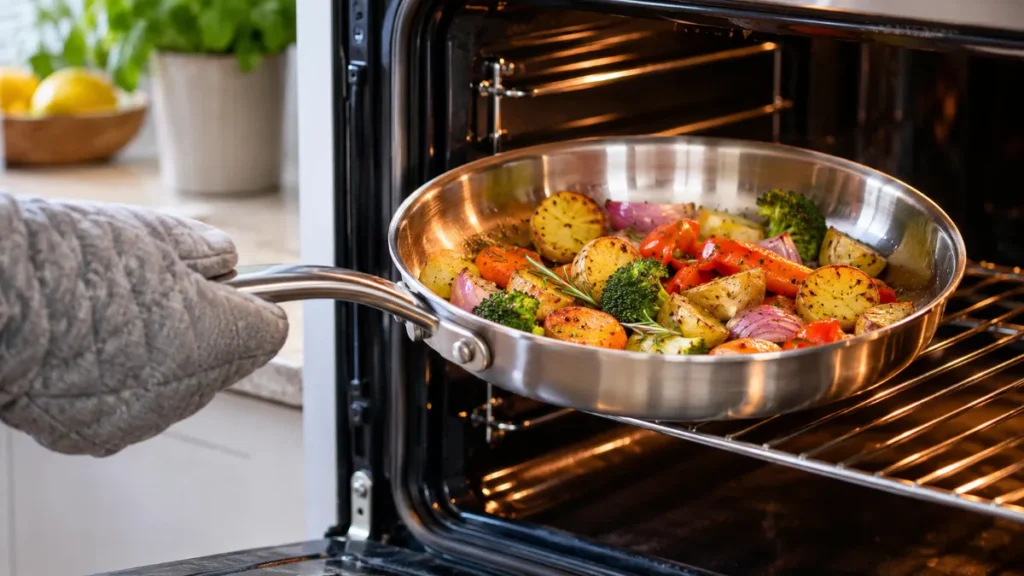
Short answer: Some Belgique pans may be oven-safe, but it depends on the specific collection, materials, handles, lids, and manufacturer instructions. Stainless steel cookware is generally more suitable for oven use than nonstick cookware, but you should never assume every Belgique pan can handle the same temperature.
If you own older Belgique cookware or are considering buying a secondhand piece, identifying its construction is the first step. Different Belgique pans may have different oven limitations, particularly when comparing stainless steel, nonstick interiors, and glass lids. Here is how to check your cookware before putting it in the oven.
1. Stainless Steel Belgique Pans and Oven Safety
Stainless steel cookware is generally a better candidate for oven use because the metal itself can tolerate temperatures much higher than most home ovens. However, the entire pan assembly matters, not just the cooking surface.
A stainless steel Belgique saucepan or skillet with all-metal construction may be suitable for oven cooking, provided its manufacturer specifications allow it. The handles, lid components, and any bonded materials must also be considered.
- Handles: Solid stainless steel handles are generally more heat-resistant than plastic or rubber-coated alternatives.
- Lids: A stainless steel lid may tolerate oven temperatures better than a glass lid with a plastic knob.
- Construction: Check whether the handle is attached with metal rivets or includes heat-sensitive components.
- Temperature rating: Follow the maximum oven temperature specified for the complete cookware piece.
2. Nonstick Belgique Pans Have Lower Temperature Limits
Nonstick Belgique cookware requires more caution. Its metal body might tolerate oven heat, but the coating can have a much lower temperature tolerance.
Traditional PTFE-based nonstick coatings can begin deteriorating when exposed to excessive heat. Temperatures around 500°F and above are particularly concerning for PTFE cookware, while manufacturers commonly recommend staying considerably below that level during normal cooking.
Ceramic-coated cookware also has temperature limitations. Although ceramic coatings differ from traditional PTFE coatings, the pan’s complete construction still determines whether oven use is appropriate.
For a nonstick Belgique skillet, check:
- The exact nonstick coating type, if identified.
- The manufacturer’s maximum oven temperature.
- Whether the handle contains silicone, plastic, or another heat-sensitive material.
- Whether the pan has a removable handle or detachable components.
3. Glass Lids, Plastic Knobs, and Handle Materials
The lid and handles can become the weakest parts of an otherwise oven-compatible pan.
Glass lids are particularly important because tempered glass is not automatically suitable for every oven temperature. Some lids are designed for stovetop cooking only, while others have specific oven temperature ratings.
The lid knob can introduce another limitation. A glass lid with a plastic or rubberized knob may have a lower heat tolerance than the glass itself.
Consider these common materials:
4. Can Belgique Pans Go Under the Broiler?
Broiler cooking is different from ordinary oven baking. Instead of surrounding the cookware with relatively consistent heat, a broiler directs intense radiant heat toward the food and the exposed surfaces.
This makes broiler safety especially important for older cookware with uncertain construction.
Even if a stainless steel Belgique skillet is suitable for regular oven cooking, that does not establish that it is safe under the broiler.
- Never broil with a nonstick pan unless the manufacturer explicitly permits it.
- Avoid broiling with glass lids unless specifically approved.
- Check whether handles and exterior coatings can tolerate broiler exposure.
- Keep the pan away from direct flame if the instructions prohibit it.
- Never use cookware with loose handles, cracks, or damaged coatings.
5. How to Check Your Belgique Pan Before Oven Use
Older Belgique cookware can be difficult to identify because different collections and manufacturing periods may have used different materials and construction methods.
If you are unsure whether your particular piece is oven-safe, follow this identification process.
Step 1: Identify the cookware material.
Determine whether the pan is stainless steel, aluminum, cast aluminum, nonstick-coated, or another material. Appearance alone may not reveal the coating or internal construction.
Step 2: Look for identifying information.
Check the bottom of the pan, handle, original packaging, instruction booklet, and any model markings. Record the collection name or model number if available.
Step 3: Inspect the handles and lid.
Look for plastic inserts, silicone grips, glass components, and removable attachments. Each component may have a different temperature limit.
Step 4: Find product-specific documentation.
Step 5: Consider the condition of older cookware.
Frequently Asked Questions
Can I put a Belgique stainless steel skillet in the oven? Possibly. Stainless steel construction is generally suitable for oven cooking, but check the specific skillet’s handles, attachments, and manufacturer temperature rating before using it.
Are Belgique glass lids oven-safe? Not necessarily. Tempered glass lids can have different temperature limits, and plastic knobs may introduce additional restrictions. Check the lid’s own specifications rather than assuming it shares the pan’s oven rating.
Can I put an old Belgique nonstick pan in the oven? Only if you can identify the model and confirm its oven-safe rating. Older nonstick cookware may have coatings or handles that are not designed for oven temperatures. When documentation is unavailable, avoid oven use.